HRIS and ATS: How to Choose the Right HR Tool?
HRIS digitalizes all HR management (payroll, leave, etc.), ATS focuses on recruitment. Discover their differences and how to choose the right tool for your needs.

HRIS and ATS are two HR tools offering distinct functionalities: HRIS manages all HR processes while ATS focuses on recruitment and application management. To choose well between HRIS and ATS, a company must first understand its needs: optimize recruitment, digitalize its entire HR process, etc.
Hesitating between an ATS and HRIS? JobAffinity helps you understand the differences between these two tools, their benefits, and how to choose the right tool according to your company size, objectives, and functioning.
ATS and HRIS in Summary
- Recruitment ATS optimizes recruitment performance: application centralization, task automation, better candidate experience, dedicated career site, and smooth collaboration between recruiters and managers.
- HRIS manages all human resources (payroll, leave, training, etc.) and structures overall HR management: employee data centralization, HR process optimization, company support at each employee journey stage.
- An ATS can be integrated into an HRIS to combine recruitment efficiency and unified HR management.
- The right choice depends on your priorities: upcoming recruitment volume, need to digitalize all HR, recruitment process strengthening, etc.

What is an HRIS?
HRIS, or Human Resources Information System, is a tool designed to digitalize and centralize employee administrative management. It brings together all essential personnel management functionalities: monitoring, leave management, skills evaluation, training, internal mobility, or administrative declarations.
Complete and transversal, it enables HR teams to:
- Automate time-consuming tasks,
- Make data reliable,
- Improve traceability,
- Offer comprehensive human resources view to better support employees in their journey.
Three types of HRIS are generally distinguished:
- Specialized HRIS (payroll, training, working time).
- Modular HRIS (customizable according to needs).
- Integrated global HRIS (complete employee lifecycle management).
What is an ATS?
ATS, or Applicant Tracking System, also called recruitment software, is a tool specifically dedicated to managing the recruitment process**. Unlike HRIS, it doesn't cover all HR but focuses solely on talent acquisition stages:
- Job posting publication,
- Application tracking,
- CV processing,
- Communication with candidates.
ATS thus enables recruiters to centralize all applications, automate certain tasks (acknowledgments, sorting, follow-ups), and gain recruitment process fluidity. It therefore contributes to improving recruitment quality and responsiveness, while offering better candidate experience.
This recruitment software can take the form of software or an online tool.

What Are the Key Differences Between HRIS and ATS?
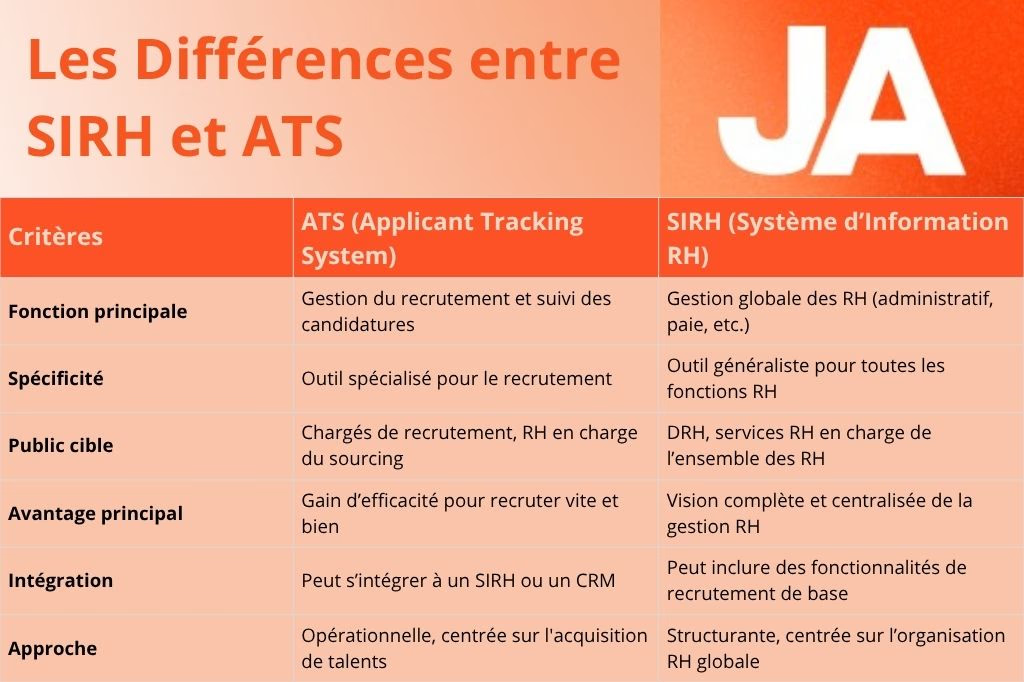
HRIS and ATS are both recruitment tools, but they fulfill different functions. ATS specializes in recruitment management, while HRIS is a more global system covering the entire employee lifecycle, from recruitment through training, leave, internal mobility, etc.
If these two solutions have different scopes, they are neither opposed nor incompatible, being on the contrary often complementary. Indeed, a company can perfectly use an ATS to strengthen its recruitment strategy, integrating it with an existing HRIS that focuses on other HR aspects.
What Are the Benefits of ATS and HRIS?
ATS focuses on recruitment performance, while HRIS aims to optimize overall HR management**.
ATS Benefits
ATS is the essential HR tool for any company wanting to automate its recruitment processes and recruit the best profiles:
- It centralizes applications and facilitates CV sorting.
- It enables multi-posting job offers in a few clicks across multiple platforms.
- It automates time-consuming tasks: job posting publication, candidate responses, follow-ups, notifications, etc.
- Very useful in public sector, it solves challenges related to attractiveness and recruitment management.
- It considerably reduces processing times.
- It improves recruitment communication between departments (HR, managers, management) through shared application view.
- It contributes to **better candidate experience and employer brand, with faster responses, clearer journey, and dedicated career site.
- It easily integrates with other HR tools to create richer ecosystem.
HRIS Benefits
HRIS is a more global solution, designed to structure and automate all company HR processes:
- It streamlines daily HR management: onboarding, administrative management, absence tracking, payroll, leave, interviews, training.
- It's a tool used more for HR management after hiring.
- It offers centralized view of all employees and their journey.
- It's particularly suited to structures needing complete and sustainable HR organization.
In return, HRIS is often more expensive, more complex to deploy, and requires team training for proper adoption. If it can integrate basic recruitment features, it remains less performing than ATS on this point.

How to Choose Between ATS and HRIS?
ATS and HRIS are tools each responding to different needs. To choose the most suitable tool, you must follow certain reflection steps:
- Consider your company size.
- Identify your needs: do you need to optimize recruitment, digitalize HR management, both?
- Establish a budget.
- Compare available market solutions: offered features, interface, integration, customer support, pricing, etc.
- Consult customer reviews.
- Request a demonstration to test different tools and their features.
- Validate your choice and plan team deployment.
Why Choose ATS?
ATS is often the right choice if:
- Your company is in growth phase and plans significant recruitment volume.
- You want to accelerate recruitment by centralizing applications and automating repetitive tasks.
- You need a tool to optimize talent sourcing, create a candidate pool, improve application tracking, and streamline HR-manager communication.
- You want to strengthen your employer brand with personalized career site and better candidate experience.
However, you must follow certain best practices to choose your ATS software well.
Why Choose HRIS?
HRIS is better suited to your company if:
- Your recruitment needs are limited, but you want to digitalize human resources management overall.
- You need centralized employee view, with modules covering all your daily work aspects.
- You're a medium to large company, with multiple HR processes to automate.
- **Your priority is to structure, make reliable, and streamline HR data, serving overall organization performance.
The choice between ATS and HRIS therefore entirely depends on your HR strategy. You can opt for one or the other according to your priorities, but also choose to combine them: an ATS to boost recruitment, integrated with HRIS for global HR management.
Now you know everything about the difference between ATS and HRIS. Looking for software that facilitates recruitment and supports you at each process stage? Choose JobAffinity, the ATS designed for recruiters**. Enjoy key features for simplified management and effective collaboration. JobAffinity also offers easy integration into your HR environment, functioning alone or complementing your HRIS.
FAQ
What is the difference between HRIS and intranet?
HRIS is a management tool that manages HR processes, while intranet is an internal communication space designed to distribute documents, news, or practical resources to employees.
Can you connect ATS to HRIS?
Yes, ATS can absolutely be integrated into HRIS. This is actually quite advantageous, allowing you to centralize candidate data and streamline the passage from recruitment to onboarding in a single system. Candidate data can thus be automatically transferred to HRIS upon hiring, for optimized management.
Is ATS suitable for small companies?
Yes, many ATS are designed for micro and small businesses. They're easy to implement, intuitive, and save time from first recruitments, without being too complex to deploy.