AI-generated applications: how to screen when everything looks the same
45% of candidates use AI to write their resume. Your applications all look alike. A practical guide to adapting your screening process.
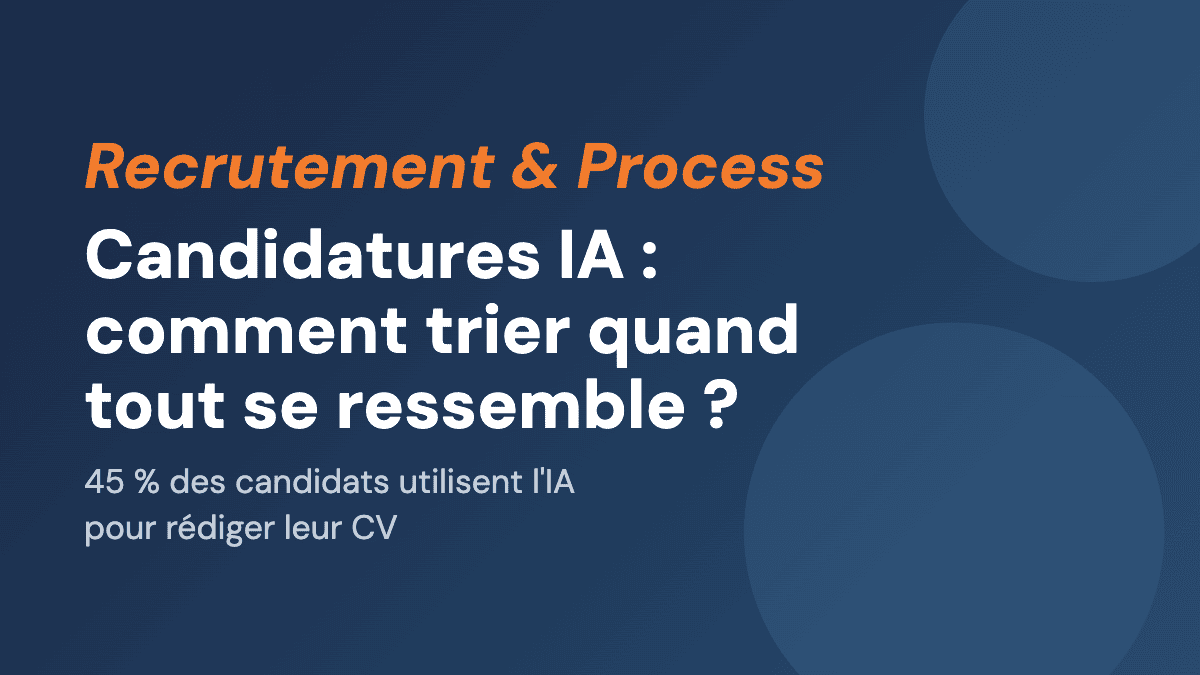
45% of candidates now use AI to write their resume. That is the figure from the Resume Genius 2025 survey. And if you recruit in services or tech, it is probably well above that.
The result, you see it every morning when you open your ATS: the same phrases, the same structure, the same adjectives. "Technology expert," "seasoned communicator," "proactive contributor in a demanding environment." You are reading the same profile on repeat. You have just discovered what is called the "sea of sameness."
We are not going to write the panic piece. What we will do is look at what this concretely changes for your work as a recruiter. And how to adapt without burning the midnight oil.
Why all resumes look the same now
The phenomenon is not imaginary. LinkedIn records 11,000 applications per minute. AI-assisted application tools have driven volumes up by 45% in one year. And 64% of recruiters report a rise in identically formatted resumes since 2024.
The mechanics are simple. ChatGPT has internalized the rules of the "perfect" resume. It produces phrases calibrated to pass ATS filters. It uses the keywords from the job listing. It structures the career history in a clean format. The result: a junior candidate with two years of experience produces a resume that looks like a senior with ten years on the job. The packaging is the same. It is as if every candidate showed up to the interview in the same suit. The suit is impeccable, but you no longer know who is wearing it.
Khyati Sundaram, CEO of Applied, sums up the problem well: "We see more and more candidates who copy-paste the form into ChatGPT. We receive a barrage of similar structures."
What this changes for the recruiter
Three direct consequences.
Traditional resume screening no longer works. When a majority of applications use the same keywords, the same phrasing, and the same structure, your ability to tell a strong profile from an average one based on the resume alone drops to zero. Keyword "filters" become sieves: everyone passes, or no one does.
Volume explodes without quality following. One hiring manager received 2,309 applications for 20 positions. A 300% increase. Not because the role was more attractive, but because applying with AI takes 30 seconds. The result: more noise, less signal.
Trust erodes on both sides. 40% of candidates admit their recruiter detected AI use in their application, and among them, 35% were not selected (ResumeTemplates 2024 survey). On the recruiter side, skepticism is growing: AI adoption among HR professionals dropped 15 points between 2024 and 2025. When the candidate doubts the process and the recruiter doubts the resume, nobody wins.
The truth no one wants to say
The resume was already a poor predictor of job performance before ChatGPT.
Work psychology studies have shown this for decades: the unstructured resume predicts on-the-job performance about as well as a coin toss. AI did not break resume screening. It made visible a flaw that always existed. We were evaluating the ability to write a resume, not the ability to do the job.
And if you are using an AI scoring tool to screen these AI-generated applications, you are caught in an absurd loop. One AI is grading another AI's work. We detailed this trap in our article on AI scoring in recruitment: the score reflects prompt quality, not candidate quality.
How to adapt in practice
No need to revolutionize your process. Three adjustments will do.
1. Reduce the weight of the resume in your decision
The resume becomes a binary filter: the candidate meets the basic prerequisites, yes or no. Required degree, compatible location, minimum experience. Full stop. Stop spending 5 minutes analyzing the phrasing. It is no longer the candidate's own words.
A concrete exercise for tomorrow: take your last 3 successful hires. Look at the selected candidate's resume. Was it the resume that convinced you, or the interview? In 9 cases out of 10, it was the interview.
2. Structure your interviews
The structured interview remains the best predictor of on-the-job performance. It rests on three principles: the same questions for every candidate, an evaluation grid defined in advance, and situational questions ("Tell me about a time when...") rather than resume-based questions ("Tell me about your experience at X").
A candidate who used ChatGPT for their resume cannot use ChatGPT in a face-to-face interview. That is where the difference is made. A recruiter who asks the right question at the right moment is worth more than any parsing algorithm.
3. Make your ATS work on what matters
Your ATS should not only be parsing resumes and sorting keywords. If that is all it does, it is playing exactly the game that candidate-side AI has learned to beat.
A useful ATS in 2026 is a tool that centralizes your interview notes, preserves the history of exchanges with a candidate, and feeds an exploitable talent pool for your next hires. A candidate passed over today could be the right fit in six months. But only if you have recorded why you passed on them, and on what criteria.
At JobAffinity, that is exactly the approach we advocate: less automated screening on keywords that everyone can produce, more tools to evaluate, rate, and retrieve candidates on human criteria.
The real subject is you
Candidate-side AI is not a threat. It is a mirror. It sends you back to the question recruitment should have asked long ago: are we evaluating the right signals?
The recruiters who adapt fastest are not those buying an AI detector. They are the ones who have understood that structured interviews, rigorous note-taking, and a well-maintained talent pool are worth more than an automated score on a resume written by a machine.
The ChatGPT-standardized resume is here to stay. The question is not how to detect it. The question is: what do you do after the resume?
Topics covered:
Ready to discover JobAffinity?
Join over 10,000 users already recruiting with our reliable and intuitive French ATS.
Discover JobAffinity