Declining mobility: how to adapt your recruitment in 2026
38% of professionals are considering changing employers in 2026, down from over 50% in 2023. For recruiters, it signals a fundamental shift in method.
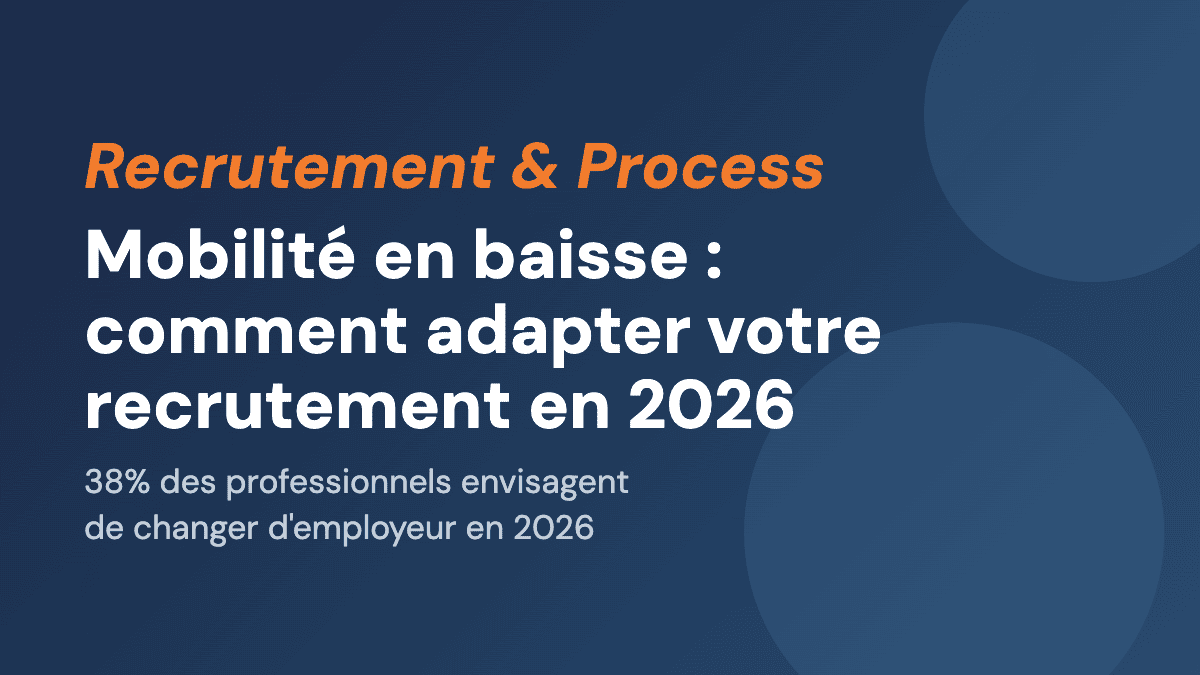
38%. That is the share of professionals still considering a change of employer in 2026. Three years ago, it was more than one in two. For a recruiter, this figure is not just a number in a report: it is the volume of resumes that no longer land in your inbox on Monday morning.
We all remember the post-Covid years when applications rolled in, profiles were on the move, and the market was in flux. That era is over.
What the numbers actually say
The INSEE/Dares data is clear: in 2024, 15.9% of private-sector employees left their employer. That is 2.4 points lower than in 2023, bringing mobility below its pre-pandemic level. The trend affects every category of employee, without exception.
The most striking part is the paradox. The desire to move has not faded. Employees still want to change, but they no longer act on it. Why? Because switching companies in 2026 means taking a risk in a context where unemployment is rising and pay increases are more generous for those who stay than for those who leave. It is like wanting to move to a better neighborhood, but realizing rents have skyrocketed: the desire is there, the decision does not follow.
Among 45-65 year-olds, only 24% say they are open to a new opportunity. Among 18-34 year-olds, the figure is still 54%, but the trend is downward across the board.
"Post and pray" has hit its limits
For years, recruiting often followed the same pattern: write a job ad, post it on a few job boards, and screen the incoming resumes. When the market is moving, that works. When candidates freeze, this reflex becomes a trap.
Posting an ad and waiting is like opening a shop on a deserted street, hoping customers will come anyway. If your candidates are no longer actively searching, they will not even see your listing. Meanwhile, the role stays open, the team compensates, and the cost of the unfilled position keeps growing.
The reality of 2026 is that the best profiles for your role are already employed. They are not scrolling job boards on Sunday evening. They are not on career sites. But they may already be in your ATS.
Your talent pool: the goldmine you are ignoring
It has been discussed for years, but few recruiters truly leverage their candidate talent pool. This reservoir of profiles accumulated through previous hiring rounds is the most effective weapon when the market contracts.
Take a concrete example. Marie, a recruiter at a mid-size industrial company, needs to fill a quality manager position. She recruited for the same profile eight months ago. In her ATS, she finds three runners-up who were not selected, not because they lacked skills, but because another candidate was a better fit. One of them is still employed, still relevant. One message, one conversation, one hire completed in two weeks instead of six.
This scenario is far from exceptional. It simply requires a well-maintained ATS and the reflex to search internally before posting externally. Among our clients, those who search their talent pool before publishing a job listing reduce their time-to-hire by 30 to 40%.
From resume screening to talent nurturing
The shift in method is easy to understand, harder to implement. It means moving from an ATS-as-funnel (lots of resumes come in, you filter, you keep one) to an ATS-as-relationship-manager (you cultivate relationships with qualified profiles over time).
In practice, this means:
Tag and qualify every candidate who goes through your process, even those you do not select. A "no" today can become a "yes" in six months.
Reactivate your database regularly. Not with generic emails, but with targeted messages. "A position similar to the one you applied for has opened up, would you be interested?" is more effective than any job board posting.
Think about former runners-up. You ran a recruitment process a year ago and now have a similar need. You hired the right candidate from a shortlist of four. Your ATS should let you find and contact those runners-up in two clicks. Yes, it was a year ago, but it takes 20 seconds to try. And as we know, you miss 100% of the shots you do not take.
Limitations to keep in mind
The talent pool is not a silver bullet. A poorly maintained pool is a resume graveyard: outdated data, expired GDPR consents, profiles who have changed careers since. If your database is not alive, it is worthless.
Let us also be honest: not every position lends itself to talent pool reactivation. A rare profile in a niche sector is unlikely to already be in your database. Proactive sourcing on professional networks remains necessary as a complement.
The Monday morning exercise
Before posting your next job ad, run this test. Open your ATS. Type the keyword for the role you need to fill. See how many relevant profiles are already sitting in your database. If you find three or more, start with them.
At JobAffinity, we designed the talent pool search to take less than two minutes. Filter by keywords, by pool, by location, by last interaction date. Because we know that in a market where candidates no longer come to you, you need to go find them. And more often than not, they are already there.
Topics covered:
Ready to discover JobAffinity?
Join over 10,000 users already recruiting with our reliable and intuitive French ATS.
Discover JobAffinity